
Borrowed Beauty
Why PMI's playbook is so easy to admire, so easy to copy — and so nearly impossible to reproduce.


There is a story in the 莊⼦ Zhuangzi, about a woman named ⻄施 Xi Shi. She was one of the celebrated beauties of ancient China, and she suffered from some ailment of the chest. When the pain came on, she would press her hand to her heart and knit her brow. The villagers, already half in love with her, found even this gesture lovely.
A neighbour named 東施 Dong Shi watched all this. She was a plain woman, and she concluded that the secret lay in the frown. So she took to walking through the village clutching her chest and knitting her brow in imitation. When the rich of the village saw her, they bolted their doors and would not step outside; when the poor saw her, they gathered up their wives and children and fled. Dong Shi had grasped that the frown was admired; what escaped her entirely was why it was admired.
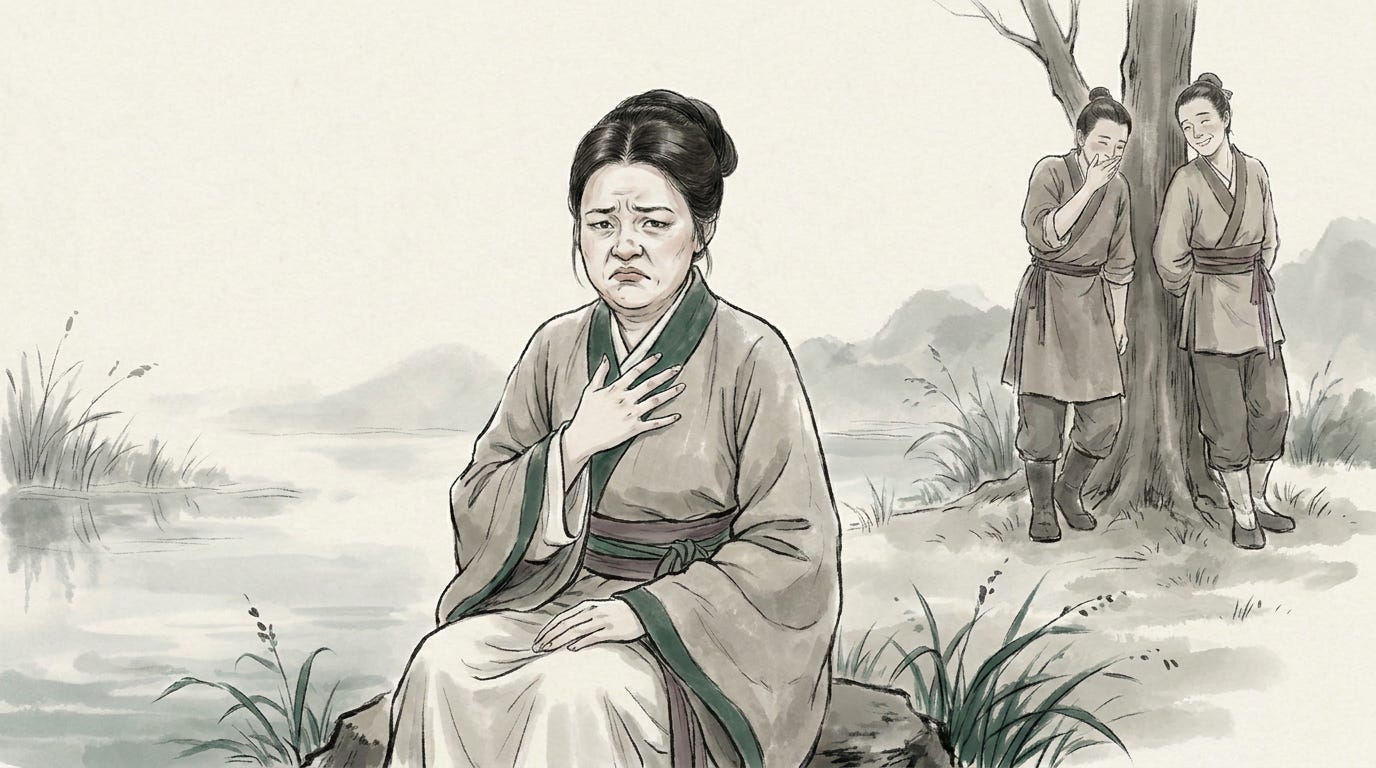
This is 東施效顰 — literally “Dong Shi imitates the frown” — the phrase Chinese has used for two thousand years for imitation that captures the form of a thing and loses its essence. What has kept the story in my mind through a career of reading company disclosures is that Dong Shi’s failure was not one of effort. She copied faithfully. Her failure was one of attribution: she fixed on the one visible variable and never asked what made that variable work in the first place. That precise error — mistaking the visible gesture for the hidden quality standing behind it — is one I watch the capital markets commit, in a more respectable dialect, almost every quarter.
This is 東施效顰 — “Dong Shi imitates the frown.” I have been thinking about it a great deal lately, because I cannot find a cleaner description of a mistake I watch professional investors and corporate boards make almost every quarter.
The question everyone asks, and the question they should
Investors spend their careers searching for the next great compounder — the next Nvidia, the next Apple, the next Micron. Having found the winner, the reflex is to turn to everyone in the adjacent seats and ask why they are not doing the same thing.
Most professional investors are not naive enough to believe a genuine franchise can simply be photocopied; they know a near-monopoly when they see one. However, it is common for professional investors and credit rating agencies to benchmark the laggard against the leader on the leader’s own scorecard and to read any shortfall as proof that the laggard’s modus operandi is suboptimal. Sit through enough earnings calls, and you hear the milder, more respectable form of it: the competitor is compounding at twenty per cent, so why are you stuck at two, and what is your plan to close the distance? The premise buried inside the question is that the leader’s chosen metrics are the right yardstick for everyone at the table, and that the gap is a problem waiting to be fixed.
I hold a meaningful slice of my net worth in Philip Morris International, so I will declare the bias plainly. I admire the company. IQOS, ZYN, and a Marlboro franchise that refuses to age have put it in a position almost nobody else in this industry can claim. That position has earned it the right to speak with some confidence, which it did at the recent dbAccess Global Consumer Conference.
What PMI actually said
Damian McNeela of Deutsche Bank put the natural question to Jacek Olczak: how should investors think about prioritising value from combustibles while trying to drive the smoke-free business? The answer is worth reading closely.
Olczak led with the figures everyone quotes. On long-term resource allocation — R&D and capex — more than 90% now sits behind smoke-free. Capex on combustibles runs well below the depreciation on combustibles. No new cigarette factory in 10 years, against 16 new manufacturing centres for smoke-free products. Three-quarters of commercial spend is behind the smoke-free portfolio.
The sentence that should have made everyone put their pen down came a beat later:
“We will borrow from the past business the best of the things which we like in the past and try to protect them and enhance them in the new business. One of them is profit margin. Another is the high cash conversion. I can go on and on and on... we’re trying to take ability to build the great brands like Marlboro, and now we’re trying to use it for IQOS.”
Investors often score this industry by smoke-free revenue mix, by smoke-free user counts, by category growth rates — the visible, citable numbers that fit in a headline. Olczak was telling us those figures are the symptoms; the substance lies underneath them. The test he is actually running is whether the new business inherits the qualities that made the old one a great asset in the first place: margin and cash conversion. Strip away the language, and the question is brutally simple. At the end of the day, is the transformation producing more free cash flow?
Give that inherited quality its proper name. It is PMI’s endowment: the advantage a business begins with, which quietly decides which strategies are even available to it. PMI’s achievement is not that it shifted the portfolio; plenty of firms have shifted portfolios. It is that it carried its endowment — the margin and the cash generation — across the bridge intact and, on its own telling, enhanced it.
The frown that only works on one face
You can then imagine a board member at a rival firm turning to their own management with the inevitable line: “This is how PMI did it — what are we learning, and how do we close the gap?”
The trouble is that a strategy is only a move, and the same move made by a different firm is simply a different move. Notice what each of PMI’s moves actually rests on, and why none of them survives transplantation.
It can redirect 90% of its development capital away from cigarettes because it already owns a scaled, profitable, category-leading successor for that capital to flow into. IQOS holds roughly three-quarters of the global heat-not-burn market more than a decade after its launch. Redirecting money away from the highly profitable cigarette business is a sound decision only once there is somewhere credible — and genuinely cash-generative — for the value to land. A rival that copies the funding shift without owning such a destination is not executing PMI’s strategy; it is merely running down a franchise and calling the result a transformation.
The way PMI extracts value from combustibles works for the same underlying reason. Marlboro remains the world’s number one aspirational cigarette brand, and it sustains that standing on remarkably little marketing reinvestment — the very feature that makes its cash conversion so extraordinary. No other cigarette brand possesses that property. For anyone else, pushing price for a few quarters while withholding brand support is an open invitation to lose share. Q1 2026 made the point with force: Japan Tobacco and KT&G both posted strong cigarette volume gains, with KT&G delivering double-digit global volume growth in a category that has been shrinking for decades. The pool is not expanding; they are simply taking share from incumbents who had treated their pricing power as an entitlement and their market share as a given.
Pricing power runs into the same wall, and Glo set against IQOS is the cleanest illustration. More than a decade on, Glo has still not matched IQOS on the quality Olczak keeps returning to — the consistency and satisfaction of the actual experience in the hand and the mouth, the product of years spent engineering precise heat control and validating it against real consumer preference. A rival can price its device like IQOS and wrap it in premium packaging, but a premium position holds only if the product beneath it earns the same verdict from the smoker. This is where the analogy closes: the packaging is the frown, easily copied; the verdict it is meant to signal — the experience the smoker actually trusts and returns to — is the beauty, and that cannot be copied at all.
Conclusion
東施 Dong Shi was not stupid. She was empirical. She observed that the most admired woman in the kingdom pressed a hand to her heart and knitted her brow, and she reproduced the only variable she could see. Her data was correct. Her error was one of attribution: the gesture was never the source of what she wanted.
PMI’s gestures are all observable and all reproducible — a rival can match every one by the next fiscal year and call it transformation. What it cannot reproduce is the thing the gestures never caused: a successor business — IQOS, and potentially ZYN — that inherited Marlboro’s margin and cash conversion and carried that endowment across the bridge intact.
Here, the reasoning has to hold its discipline because it is easy to invert. It is entirely correct to say PMI succeeds because of the profitability and cash conversion of the smoke-free portfolio it has built — because IQOS and ZYN now generate genuinely franchise-grade economics, not merely franchise-grade revenue. That much is true and worth stating plainly. The error begins the moment the observation is turned upside down, mistaking the branch for the root. To conclude that a rival is failing because it has not generated more than 40% of its revenue from smokefree, or that it would win if only it did, is to read PMI’s gestures as their own cause. A rival is under no obligation to win on PMI’s scorecard. It can build a different endowment on its own terms — a different geography, a different category mix, a different route to durable cash generation — and it deserves to be judged by whether that compounds, not by how closely it resembles PMI’s.
So when the board turns to management with the inevitable line: "What are we learning from PMI, and how do we close the gap?" — The honest answer is that the part of the gap that matters was never located in the strategy or revenue mix at all. The gap lives in the precondition that the strategy was built to protect and extend. A company can resolve to close a cigarette factory, or to pour capital into a smoke-free portfolio. No company can simply resolve its way to Marlboro’s margin and cash conversion.
⻄施 Xi Shi could afford to frown because the beauty was already hers. A great company can afford its strategy for the same reason: the endowment comes first, and the strategy is only what it chooses to do with it. Hold that order of causation in mind the next time a champion explains itself with a straight face, and you will read the rest of the sector far more clearly.