
Diageo: What Changes, What Doesn't
Twenty-nine years of returns, drawdowns and strategies

I had a different article planned. After Diageo’s capital markets day on 6 August, I intended to write the obvious piece — a close reading of Sir Dave Lewis’s new strategy against the one Sir Ivan Menezes laid out in November 2021, with a verdict on whether the new plan is better than the old.
Then I stopped, because I noticed something uncomfortable about my own position. I had already decided that the share price collapse since December 2021 was a story of execution failure under Menezes, and then under Debra Crew, whose strategy largely inherited his. That conviction felt solid. It also arrived, conveniently, after the share price had told me what to think.
Hindsight bias often clouds an investor’s judgement. If I had misattributed the last five years, I would misjudge the next four quarters of corporate actions, and I would be watching the wrong signposts for a recovery. So I put the article down and spent a week on something less exciting: reading Diageo backwards, from the merger of Guinness plc and Grand Metropolitan in December 1997 to the present. What has let this company compound? What has caused its drawdowns? And across twenty-nine years, what has genuinely stayed constant while everything else moved?
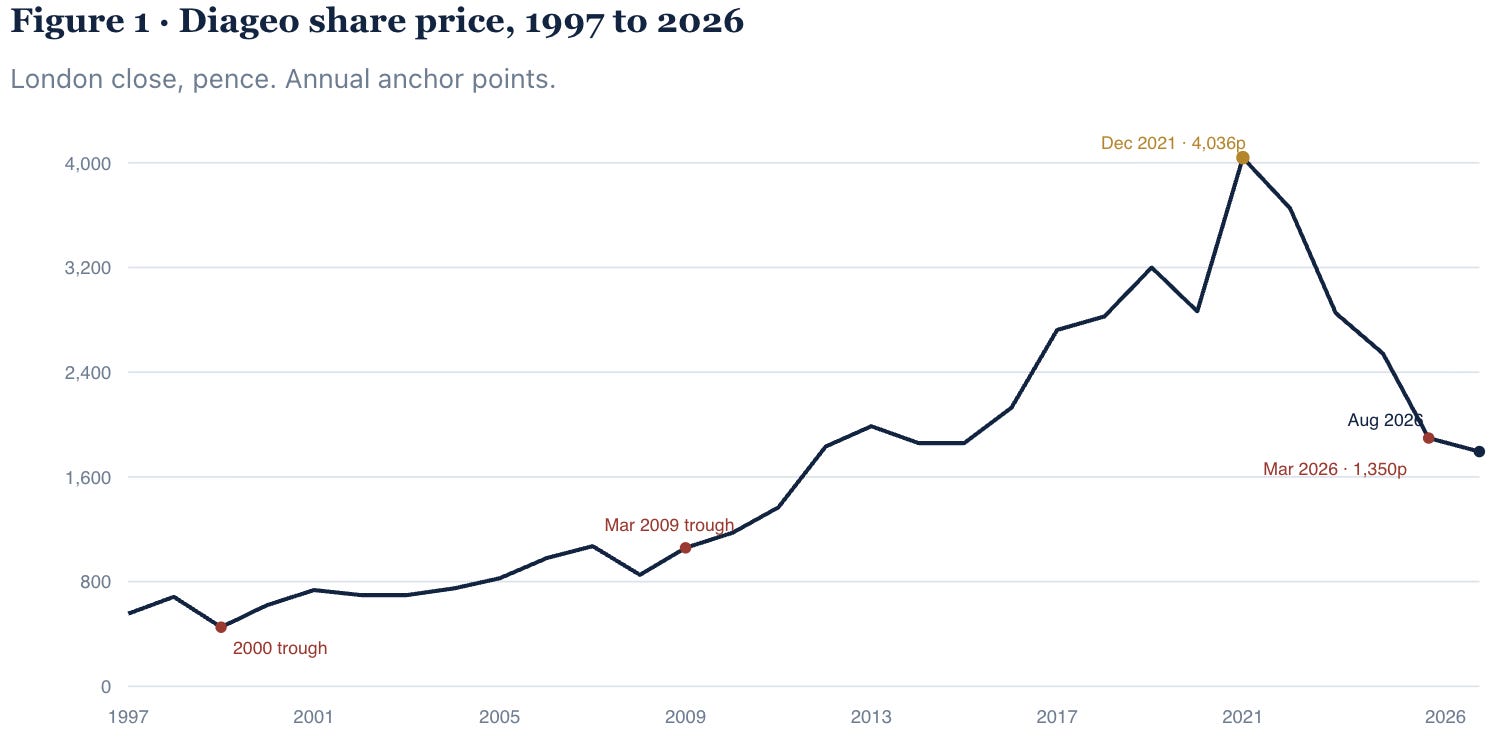
The 2021 capital markets day proved to be the ideal benchmark. It took place roughly a month before the shares reached their all-time high. The 2026 event took place shortly after Diageo experienced its worst share-price drawdown since its incorporation. Two management teams, two plans, and the widest possible gap in what the market was willing to pay while each was being explained.
At around 1,790p, the shares trade on roughly 14x earnings before exceptional items. Throughout the company’s history, that multiple has ranged from about 12x at the depths of the financial crisis to near 30x at the end of 2021. Free cash flow has been positive in every year of the 29. A dividend has been paid in every one of them, though it was cut this year for the first time.
Here is the bear case, and I want it on the table before anything else.
A multiple can fall and stay down when the terminal growth rate has permanently changed, and that is precisely what is in dispute. IWSR reclassified moderation as structural rather than cyclical during 2025 and 2026. UBS now models North American category growth at 1.3% a year through to 2035, some 200 to 300 basis points below the pre-pandemic trend. If either is right, 14x P/E is not cheap for a business compounding at 1% or 2%. It is fair, and the historical multiple range has reset to a permanently lower level.
There is a second problem. The dividend cut removes the one support that held through every previous drawdown. And the cost programme buys two years of earnings growth rather than a decade — Pernod Ricard is executing a €1bn efficiency plan across almost identical dates, at an almost identical advertising ratio.
29 years, 3 regimes
Start with the arithmetic, because it disciplines everything that follows. I have split the period at the two moments when the multiple reached an extreme, rather than at round-numbered calendar dates.
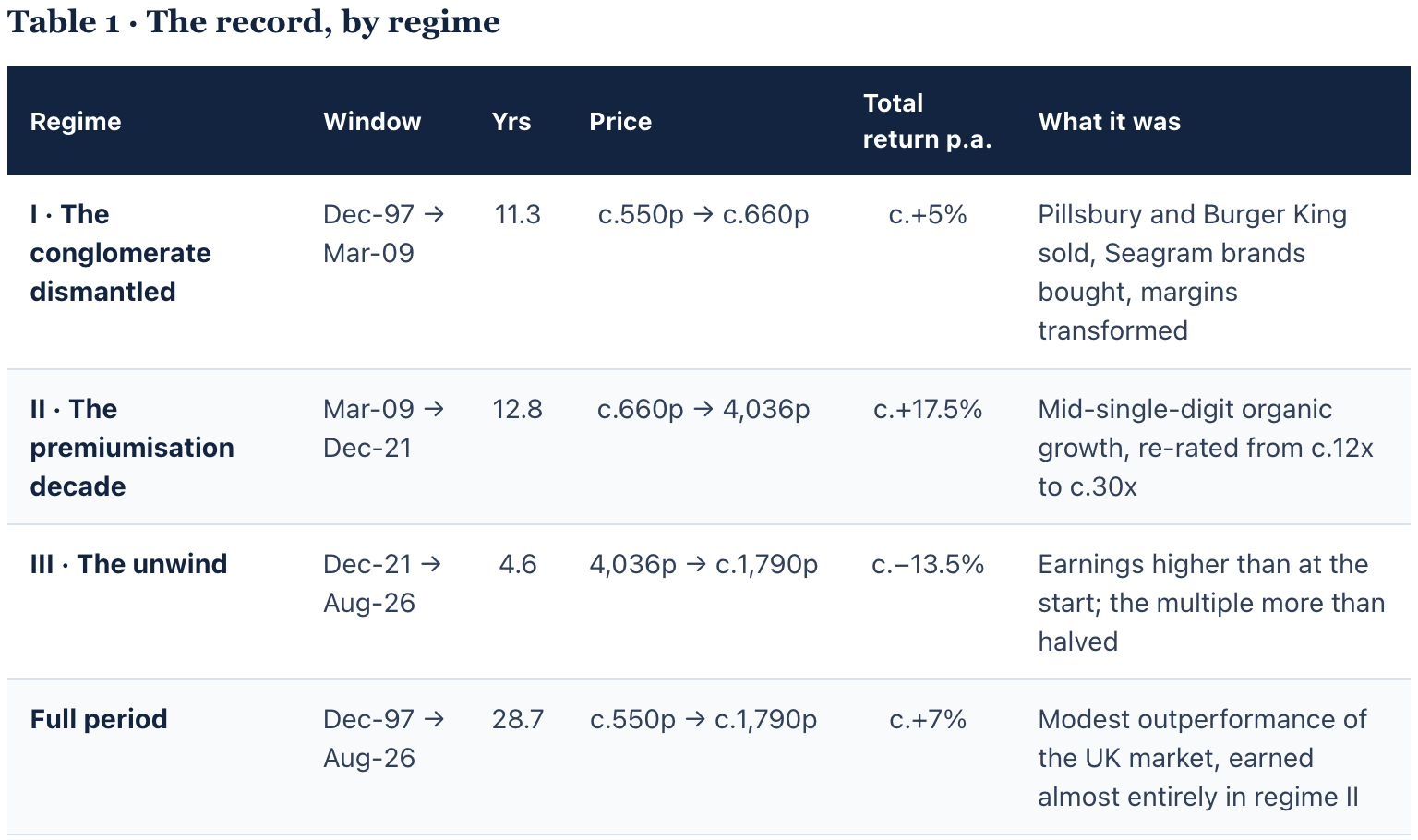
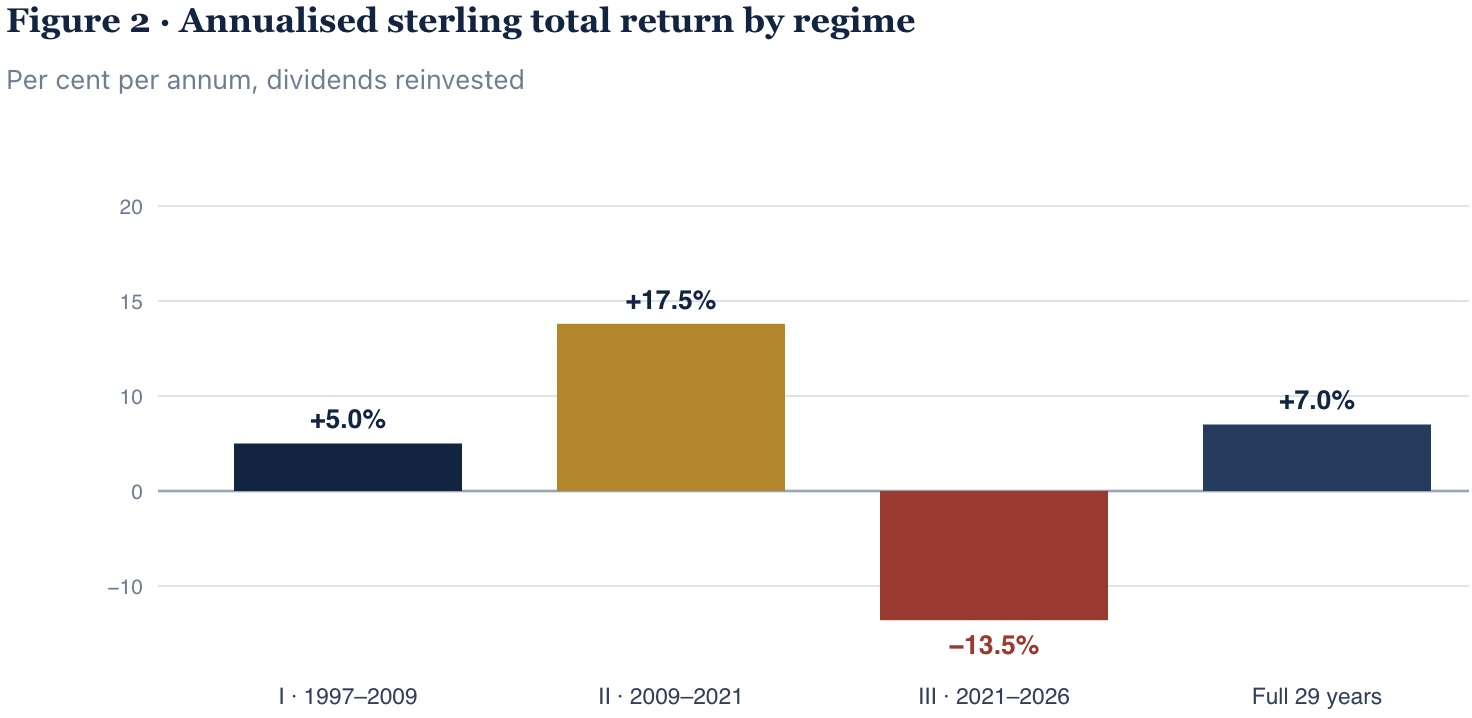
The average of 7% per year describes no one’s actual experience. Regime I paid roughly 5% across more than a decade in which Diageo was taken apart and rebuilt. Pillsbury went to General Mills. Burger King was sold. The Seagram spirits brands arrived, bringing Captain Morgan and Crown Royal. By any operating measure, this was a success.
Regime II is where the entire excess return of the twenty-nine years was earned. Regime III has taken back a large part of it.
What actually paid, and what took it away
Over the great decade, Diageo grew earnings per share at something close to 7% a year. The shares compounded at more than 15%. The gap between those two numbers is the multiple, which rose from roughly 12x at the March 2009 low to roughly 30x at the December 2021 peak. Around half of the best return this company has ever delivered came from earnings multiple expansion.
Since December 2021, the mechanism has run in reverse, and more brutally. Look at what earnings actually did.
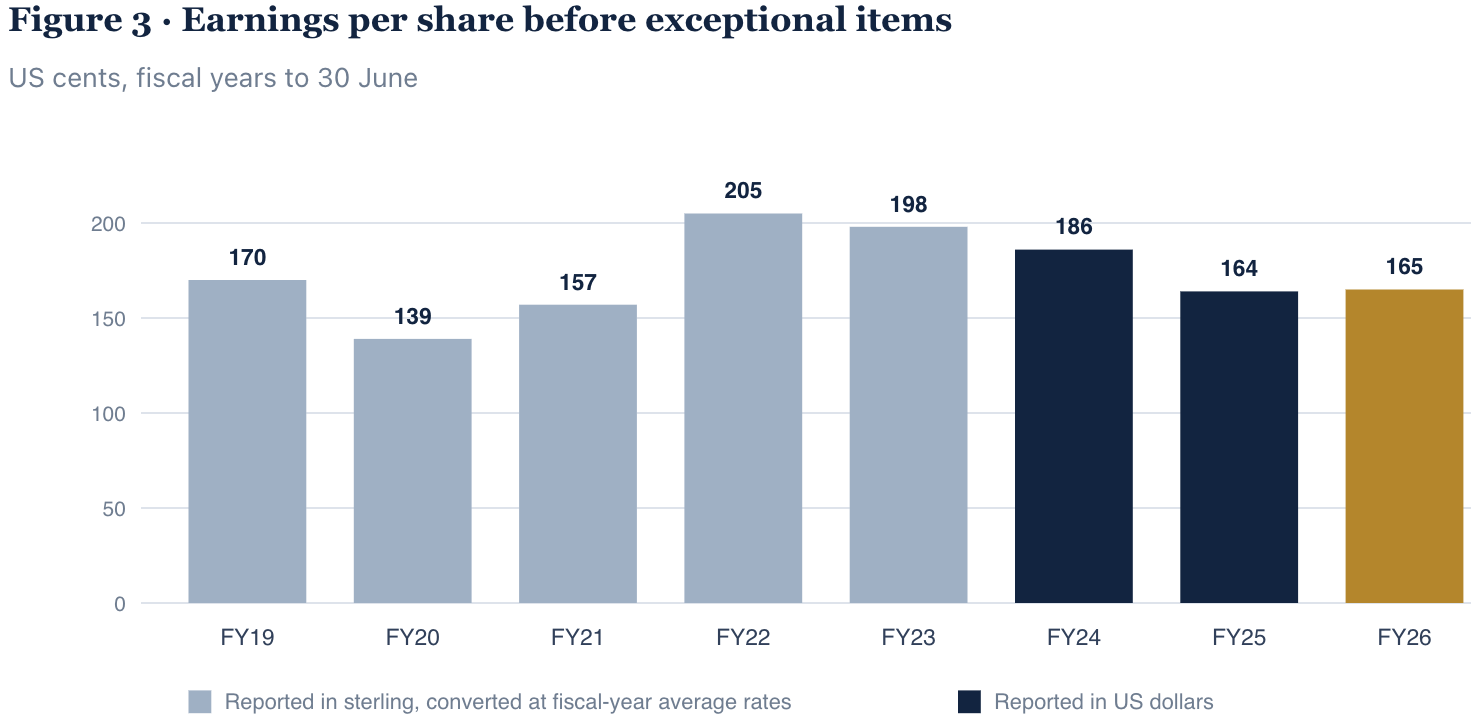
Earnings peaked in fiscal 2022 and 2023 and have since fallen by around 18%. That is a real deterioration, and I do not want to minimise it. But set it against the share price, which is down 56% from its December 2021 close. Earnings today are also comfortably above their level in fiscal 2021, the last full year reported before the shares peaked.
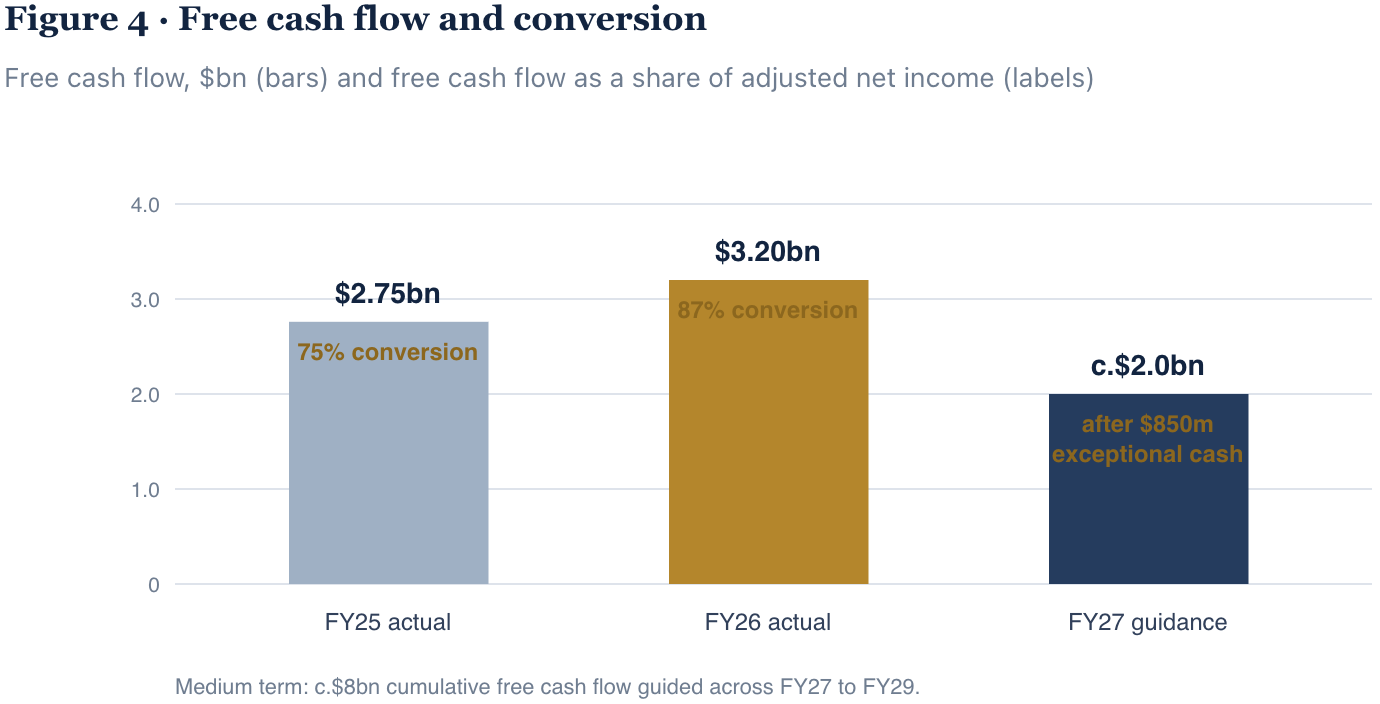
The cash has behaved in much the same way. Diageo generated $3.2bn of free cash flow in fiscal 2026, up $463m on the prior year, against organic net sales that fell two per cent. Conversion against adjusted earnings improved from 75% to 87%.
Five drawdowns, one recurring cause
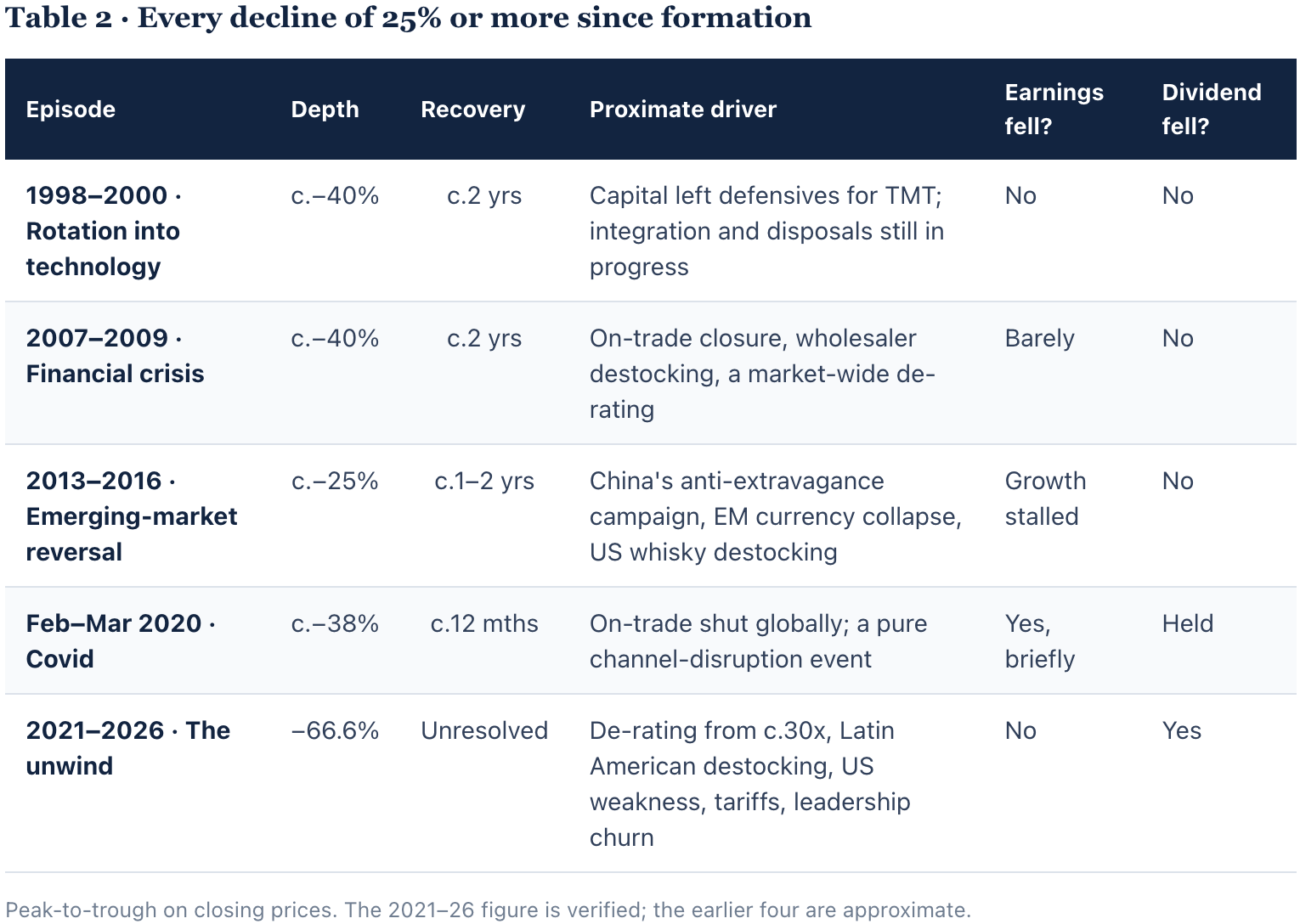
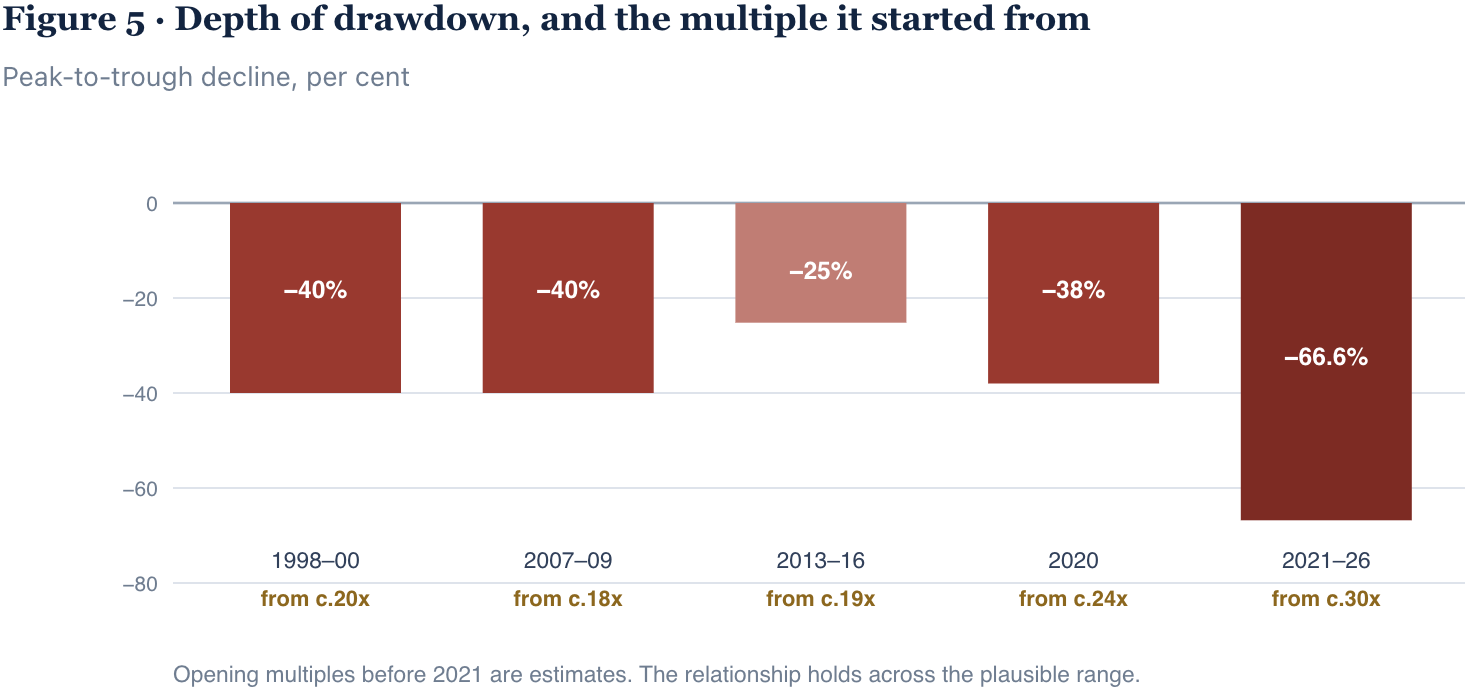
Depth tracks the multiple from which the drawdown began, not the severity of the operating problem. The 2013 to 2016 episode had the weakest earnings performance of the five and produced the shallowest decline, because it started from around nineteen times. The 2021 episode began at roughly thirty, and produced the deepest fall in the company’s history.
In none of the five did free cash flow turn negative. In none of them did a brand fail. In four of the five, the dividend still rose, and 2026 broke that pattern for the first time.
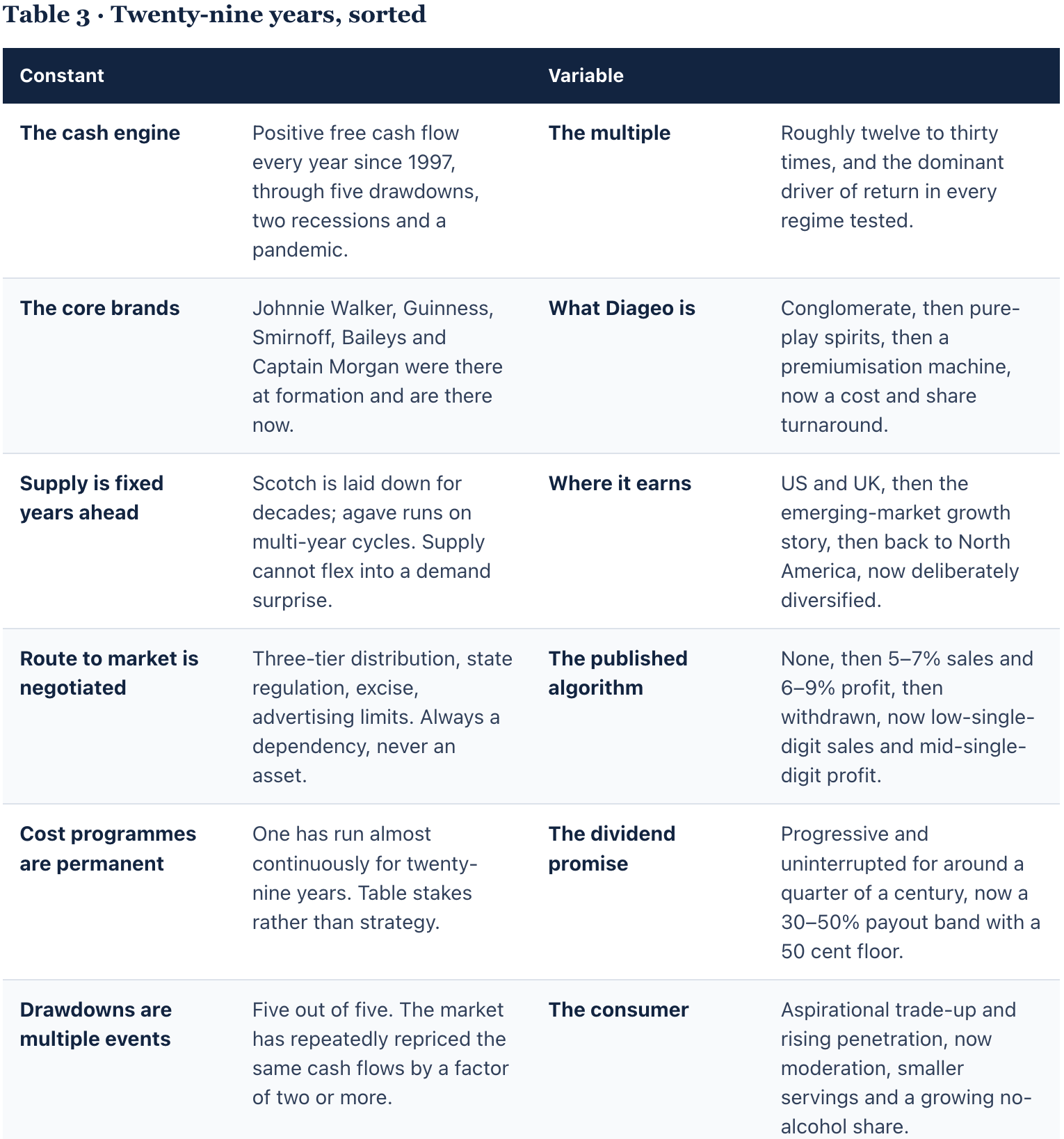
What has never changed, and what never stops changing
This is the table I built the whole exercise to produce, and it is the part I expect to still be using in 2031.
The diagnosis management always reaches for
There is one item that belongs in both columns, and it deserves its own section. In every drawdown, Diageo’s management has described the weakness as cyclical. They have been right four times out of four.
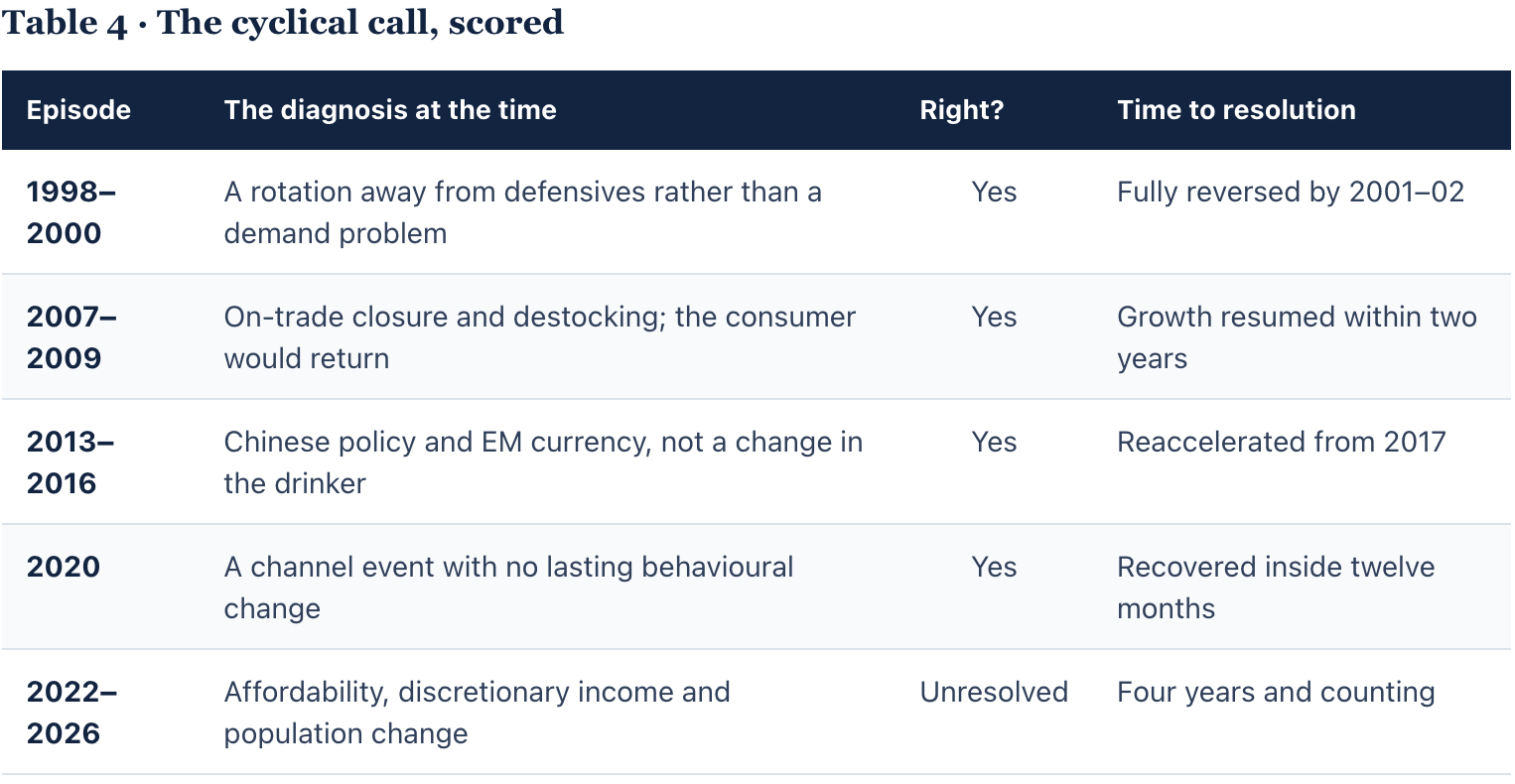
Four for four is a strong prior, and it helps explain why the market has historically bought into Diageo’s drawdowns. Anyone who dismissed the cyclical call in 1999, 2009, 2015 or 2020 gave up a great deal of money.
I would still be careful about transferring it. Each of the four correct calls concerned demand being displaced — by a channel closing, a policy change, a currency move. The claim now is that demand is lower permanently. IWSR’s consumer work finds that drinks per occasion are falling from 4.4 to 3.9, while participation holds steady at 76%. People are still drinking; they are drinking less on each occasion.
Where the two capital markets days actually fit
Which brings me back to the article I originally intended to write. Having done the historical work, I now think the strategy comparison is genuinely interesting and structurally secondary. Strategy moves the earnings line. The earnings line accounted for about half of the return in the best regime.
That said, the contrast is instructive, and one change stands out above the rest.
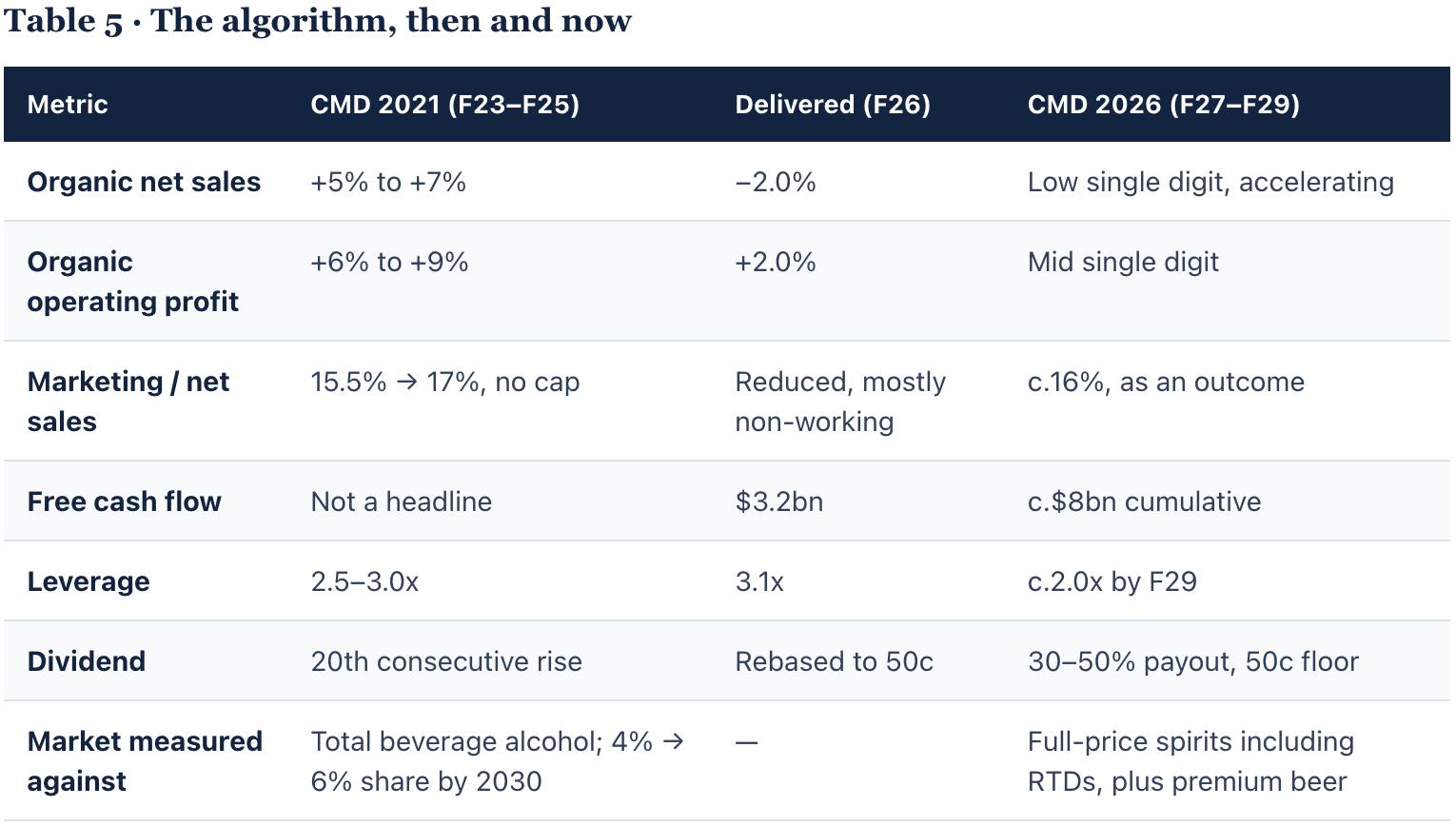
The last row is the one that matters. Four per cent of a trillion-dollar pool justifies almost any growth rate and can never be audited. The share of a market you actually compete in can be missed, publicly and annually. Lewis has also added volume share alongside value share, which is what allows the price resets on Casamigos and Bell’s to happen at all.
The 2021 algorithm was, in the end, a forecast of the market. The 2026 one is a forecast of Diageo. Nik Jhangiani said something during the Q&A that I keep returning to: that visibility in North America is now worse, not better, and that the old algorithm was withdrawn because nobody believed it. A plan built on things management controls can be wrong about the market and still protect the cash, which is what has actually mattered for twenty-nine years.
A necessary check on the new plan
Diageo is not alone. Pernod Ricard is guiding to 3% to 6% organic sales growth with €1bn of efficiencies at around 16% of sales going to advertising — the same ratio Diageo has just arrived at, having conceded that stepping up from 16% to 18% produced no growth at all. Campari is running fewer, bigger bets at around 3% organic sales growth and is roughly a year further into execution.
The framework I will actually use
#1. Is the cash still there? Twenty-nine years, twenty-nine answers of yes. This is the only question that can permanently impair the asset. Today: yes, and the new plan protects it.
#2. What multiple am I paying against the historical range? Around fourteen times, against roughly twelve to thirty. This has driven more of the realised return in every period than anything management has done. Today: near the bottom.
#3. Is the volume decline cyclical or structural? The only question that can move the range itself. Today: contested, and improving slightly at the margin.
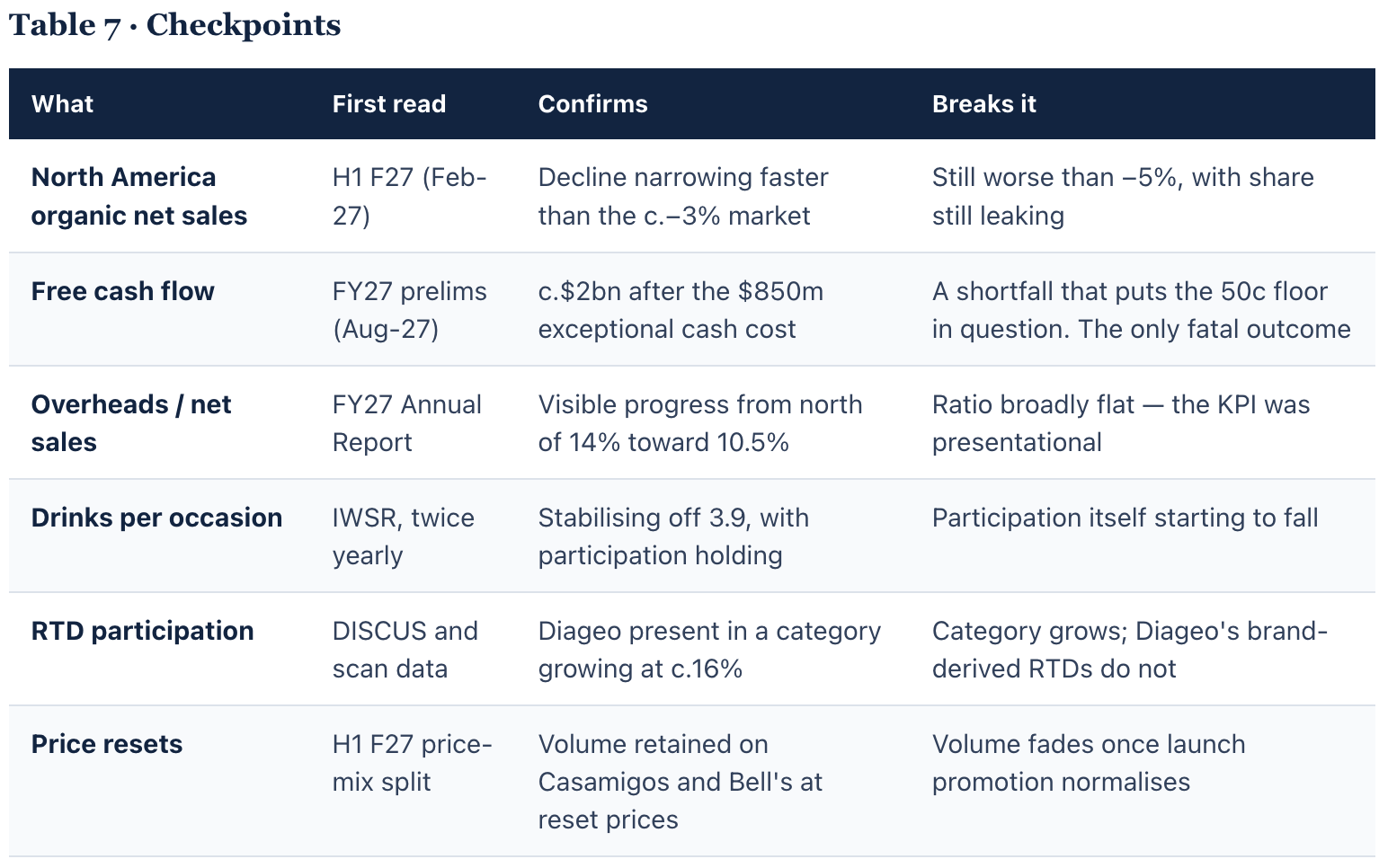
What I am watching
What would strengthen or weaken my thesis?
Closing
The week I spent reading Diageo backwards did what I hoped it would. It told me that my instinct — that this was an execution story — was partly right and partly misleading. Execution deteriorated, and earnings are 18% below their peak, which is real. But earnings are also higher than they were when the shares made their high, and the share price has halved.
In nominal terms, the shares have given back 20 years of progress, trading roughly where they did in 2006. Nobody knows how long the return journey takes.
What I do know is that in 2021 Diageo asked investors to believe a forecast, and investors paid around 30x earnings for it. In 2026 Diageo is asking investors to believe an execution, and they are paying around 14x earnings.
Never owned it but also agree it looks interesting at lower prices. I'm at the stage of my life where dividends matter, so a divvy cut is pretty much rules it out for me. I also wonder if people drink as much as people used to ? I hear anecdotally that younger people don't drink as much as the same age cohort used to. Which could be headwind for the future. Certainly where I live, where people aren't allowed to enjoy themselves anymore, alcohol excise makes a night out super expensive, and younger people can't really afford it I guess. Not sure about excise levels in other countries. I used to enjoy my Guinness when I worked on the UK :) Thanks for the article.